Content Scribble
Properties of waves
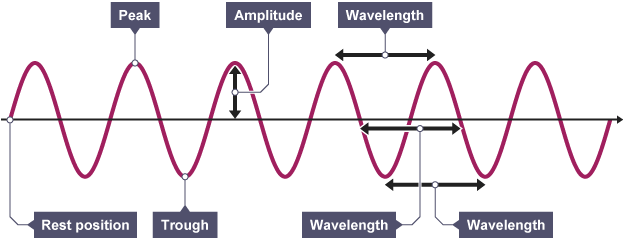
Waves are one of the ways in which energy may be transferred between stores. Waves can be described as oscillations, or vibrations about a rest position. For example:
- sound waves cause air particles to vibrate back and forth
- ripples cause water particles to vibrate up and down
The direction of these oscillations is the difference between longitudinal or transverse waves. In longitudinal waves, the vibrations are parallel to the direction of wave travel. In transverse waves, the vibrations are at right angles to the direction of wave travel.
Mechanical waves cause oscillations of particles in a solid, liquid or gas and must have a medium to travel through. Electromagnetic waves cause oscillations in electrical and magnetic fields.
All waves transfer energy but they do not transfer matter.
Parts of a wave
Waves are described using the following terms:
- rest position – the undisturbed position of particles or fields when they are not vibrating
- displacement – the distance that a certain point in the medium has moved from its rest position
- peak (crest) – the highest point above the rest position
- trough – the lowest point below the rest position
- amplitude – the maximum displacement of a point of a wave from its rest position
- wavelength – distance covered by a full cycle of the wave, usually measured from peak to peak, or trough to trough
- time period – the time taken for a full cycle of the wave, usually measured from peak to peak, or trough to trough.
- frequency – the number of waves passing a point each second
Wave period and wave speed
Period
The time period of a wave can be calculated using the equation:
Time period = 1/frequency
T=1/f
This is when:
- the period (T) is measured in seconds (s)
- frequency (f) is measured in hertz (Hz)
Speed
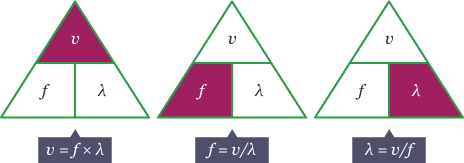
The speed of a wave can be calculated using the equation:
wave speed = frequency × wavelength
v=fλ
This is when:
- wave speed (v) is measured in metres per second (m/s)
- frequency (f) is measured in Hertz (Hz)
- wavelength (λ) is measured in meters (m)
Transverse and longitudinal waves
Waves may be transverse or longitudinal. Electromagnetic waves are transverse waves with a wide range of properties and uses. Sound waves are longitudinal waves.
Longitudinal Waves
In longitudinal waves, the vibrations are parallel to the direction of wave travel.
Examples of longitudinal waves include:
- sound waves
- ultrasound waves
- seismic P-waves
Demonstrating longitudinal waves
Longitudinal waves show areas of compression and rarefaction:
- compressions are regions of high pressure due to particles being close together
- rarefactions are regions of low pressure due to particles being spread further apart
Longitudinal waves are often demonstrated by pushing and pulling a stretched slinky spring.
Transverse Waves
In transverse waves, the vibrations are at right angles to the direction of wave travel.
Examples of transverse waves include:
- ripples on the surface or water
- vibrations in a guitar string
- a Mexican wave in a sports stadium
- electromagnetic waves – eg light waves, microwaves, radio waves
- seismic S-waves
Demonstrating transverse waves
Transverse waves are often demonstrated by moving a rope rapidly up and down.
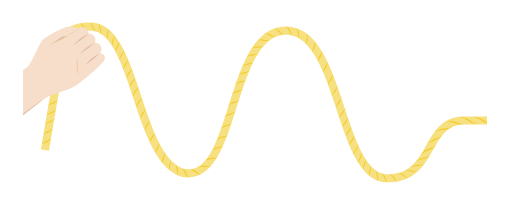
In the diagram the rope moves up and down, producing peaks and troughs. Energy is transferred from left to right. However, none of the particles are transported along a transverse wave. The particles move up and down as the wave is transmitted through the medium.
Electromagnetic Waves
Electromagnetic waves are transverse waves. Their vibrations or oscillations are changes in electrical and magnetic fields at right angles to the direction of wave travel.
All eletromagnetic waves:
- transfer energy as radiation from the source of the waves to an absorber
- can travel through a vacuum such as in space
- travel at the same speed through a vacuum or the air
Electromagnetic waves travel at 300 million meters per second (m/s) through a vacuum.
Electromagnetic spectrum
Electromagnetic waves form a continuous spectrum of waves. This include:
- waves with a very short wavelength, high frequency and high energy
- waves with a very long wavelength, low frequency and low energy
Electromagnetic waves can be separated into seven distinct groups in the spectrum.
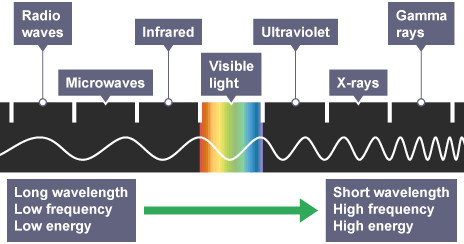
Each group contains a range of frequencies. For example, visible light contains all the frequencies that can be detected by the human eye:
- red light has the lowest frequencies of visible light
- violet light has the highest frequencies of visible light
Radio waves, microwaves, infrared and visible light
The behaviour of an electromagnetic wave in a substance depends on its frequency. The differing behaviours of different groups in the electromagnetic spectrum make them suitable for a range of uses.
Radio waves
Radio waves are used for communication such as television and radio.
Radio waves are transmitted easily through air. They do not cause damage if absorbed by the human body, and they can be reflected to change their direction. These properties make them ideal for communications.
Radio waves can be produced by oscillations in electrical circuits. When radio waves are absorbed by a conductor, they create an alternating current. This electrical current has the same frequency as the radio waves. Information is coded in to the wave before transmission, which can then be decoded when the wave is received. Television and radio systems use this principle to broadcast information.
Microwaves
Microwaves are used for cooking food and for satellite communications.
High frequency microwaves have frequencies which are easily absorbed by molecules in food. The internal energy of the molecules increases when they absorb microwaves, which causes heating. Microwaves pass easily through the atmosphere, so they can pass between stations on Earth and satellites in orbit.
Visible light
Visible light is the light we can see. It is used in fibre optic communications, where coded pulses of light travel through glass fibres from a source to a receiver.
Ultraviolet, EM waves in medicine and ionising radiation
Ultraviolet
We cannot see ultraviolet light but it can have hazardous effects on the human body. Ultraviolet light in sunlight can cause the skin to tan or burn. Fluorescent substances are used in energy-efficient lamps – they absorb ultraviolet light produced inside the lamp, ad re-emit the energy as visible light.
Electromagnetic waves in medicine
Changes in atoms and their nuclei can cause electromagnetic waves to be generated or absorbed. Gamma rays are produced by changes in the necleus of an atom. They are a form of nuclear radiation. High energy waves such as X-rays and gamma rays are transmitted through body tissues with very little absorption. This makes them ideal for internal imaging. X-rays are absorbed by dense structures like bones, which is why X-ray photos are used to help identify broken bones.
Ionising radiation
Ultraviolet waves, X-rays and gamma rays are types of ionising radiation. They can add or remove electrons from molecules, producing electrically charged ions. Ionisation can have hazardous effects on the body.
- ultraviolet waves can cause skin to age prematurely and increase the risk of skin cancer
- x-rays and gamma rays can cause the mutation of genes, which can lead to cancer
Radiation dose
Radiation does is a measure of the risk of harm caused by exposing the body to ionising radiation. Radiation does is measured in Sieverts (Sv). As radiation does figures are generally small, they are usually give in millisieverts (mSv):
1000 mSv = 1 Sv
Background radiation is all around us, all the time. Sources include:
- radioactive rocks in he Earth’s crust
- cosmic rays from space
- man-made sources such as nuclear weapons fallout and nuclear accidents.
The level of background radiation and dose are affected by factors such as the jobs that people do and the places where people live.
Reflection and refraction
All waves will reflect and refract in the right circumstances. The reflection and refraction of light explains how people see images, colour and even optical illusions.
Reflection of waves
Waves – including sound and light – can be reflected at the boundary between two different materials. The reflection of sound causes echoes.
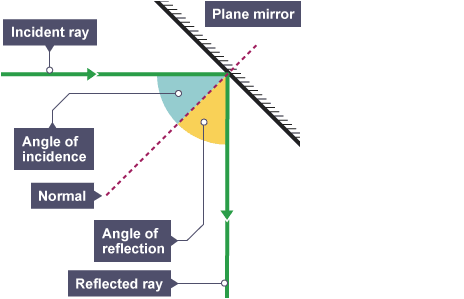
The law of reflection states that:
angle of incidence = angle of reflection
For example, if a light ray hits a surface at 32°, it will be reflected at 32°.
The angle of incidence and reflection are measured between the light ray and the normal – an imaginary line at 90° to the surface. The diagrams show a water wave being reflected at a barrier, and a light ray being reflected at a plane mirror.
Specular reflection
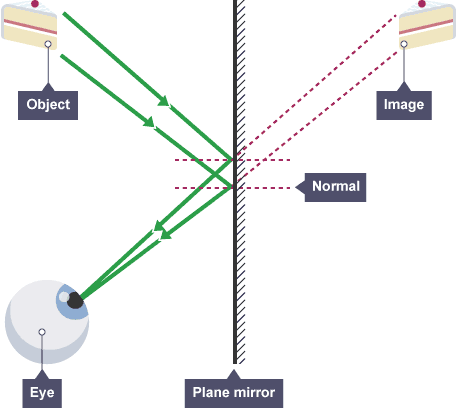
Reflection from a smooth, flat surface is called specular reflection. This is the type of reflection that happens with a flat mirror. The image in a mirror is:
- upright
- virtual
In a virtual image, the rays appear to diverge from behind the mirror, so the image appears to come from behind the mirror.
Diffuse reflection
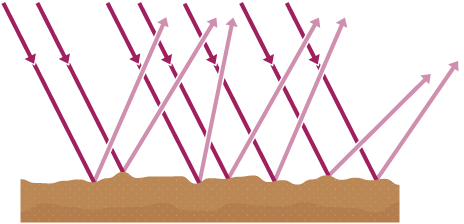
If a surface is rough, diffuse reflection happens. Instead of forming an image, the reflected light is scattered in all directions. This cause a distorted image of the object, as occurs with rippling water, or no image at all. Each individual reflection still obeys the law of reflection, but the different parts of the rough surface are at different angles.
Refraction
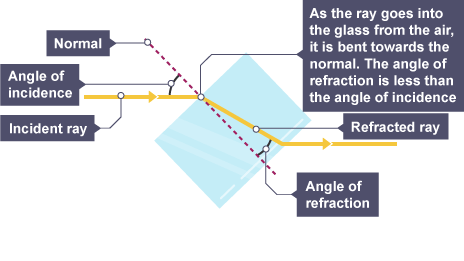
Different materials have different densities. Light waves may change direction at the boundary between two transparent materials. Refraction is the change in direction of a wave at such a boundary.
It is important to be able to draw ray diagrams to show the refraction of a wave at a boundary.
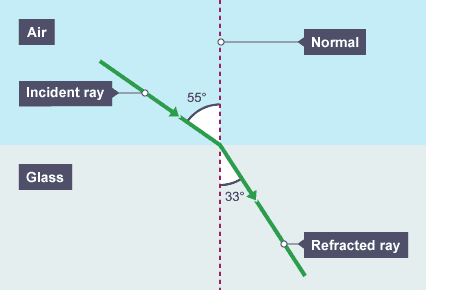
Refraction can cause optical illusions as the light waves appear to come from a different position to their actual source.
Explaining refraction
The density of a material affects the speed that a wave will be transmitted through it. In general, the denser the transparent material, the more slowly light travels through it.
Glass is denser than air, so a light ray passing from air into glass slows down. If the ray meets the boundary at an angle to the normal, it bends towards the normal.
The reverse is also true. A light ray speeds up as it passes from glass into air, and bends away from the normal by the same angle.
Wave speed, frequency and wavelength in refraction
For a given frequency of light, the wavelength is proportional to the wave speed:
wave speed = frequency × wavelength
So if a wave slows down, its wavelength will decrease. The effect of this can be shown using wave from diagrams like the one below. The diagrams shows that as a wave travels into a denser medium, such as water, it slows down and the wavelength decreases. Although the wave slows down, its frequency remains the same, due to the fact that its wavelength is shorter.
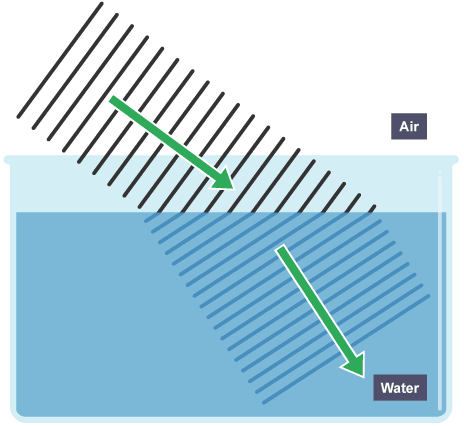
In this diagram, the right hand side of the incoming wave slows down before the left hand side does. This causes the wave to change direction.
Sound Waves
Sound waves are longitudinal waves. They cause particles to vibrate parallel to the direction of wave travel. The vibrations can travel through solids, liquids or gases. The speed of sound depends on the medium through which it is travelling. When travelling through air, the speed of sound is about 330 meters per second (m/s). Sound cannot travel through a vacuum because there are n particles to carry the vibrations.
The ear
The human ear detects sound. Sound waves enter the ear canal and cause the eardrum to vibrate. Three small bones transmit these vibrations to the cochlea. This produces electrical signals which pass through the auditory nerve to the brain, where they are interpreted as sound.
Properties of sound
The frequency of a sound wave is related to the pitch that is heard:
- high frequency sound waves are high pitched
- low frequency sound waves are low pitched
The amplitude of a sound wave is related to the volume of the sound:
- high amplitude sound waves are loud
- low amplitude sound waves are quiet
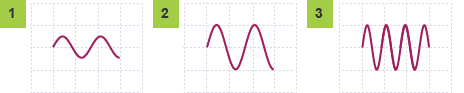
Oscilloscope traces showing the following sounds:
- quiet, low pitch sound
- loud, low pitch sound
- loud, high pitch sound
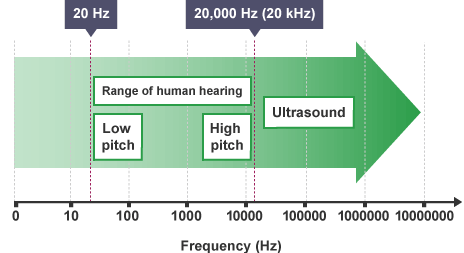
The cochlea is only stimulated by a limited range of frequencies. This means that humans can only hear certain frequencies. The range of normal human hearing is 20 Hertz (Hz) to 20,000 Hz (20 kHz).
Ultrasound
Ultrasound waves have a frequency higher than the upper limit for human hearing – above 20,000 Hertz (Hz). Different species of animal have different hearing ranges. This explains why a dog can hear the ultrasound produced by a god whistle but humans cannot.
Uses of ultrasound
Uses of ultrasound include:
- breaking breaking kidney stones
- cleaning jewellery
In both of these applications, the vibrations caused by the ultrasound shake apart the dirt or kidney stones, breaking them up. The principle is the same as the opera singer’s trick, where a glass may shatter if the singer makes a high-pitched sound near to the glass.

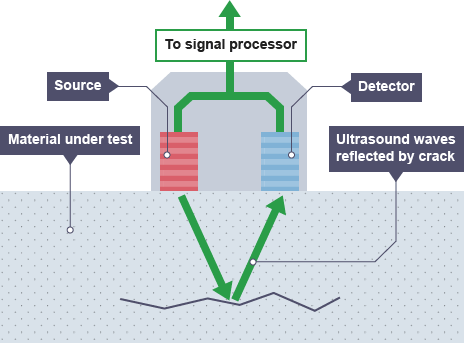
Ultrasound imaging creates a picture of something that cannot be seen directly, such as an unborn baby in the womb, or faults and defects inside manufactured parts.
These uses rely on what happens when ultrasound wave meet the boundary between two different materials. When this happens:
- some of the ultrasound waves are reflected at the boundary
- the time taken for the waves to leave a source and return to a detector is measured.
- the depth of the boundary can be determined using the speed of sound in the material and the time taken
Echo sounding
High frequency sound waves can be used to detect objects in deep water and to measure water depth. The time between a pulse of sound being transmitted and detected and the speed of sound in water can be used to calculate the distance of the reflecting surface or object. The process is very similar to ultrasound imaging. However, the sound waves used are within normal hearing range, and they are used to identify objects rather than internal structures.
This technique is applied in sonar systems used to find shipwrecks, submarines and shoals of fish. Bats and dolphins use a similar method called ‘echolocation’ to detect their surroundings and to find food.
Seismic waves
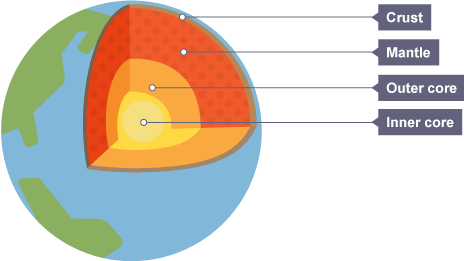
Seismic waves are produced by earthquakes in the Earth’s crust. They can cause damage to structures on the Earth’s surface, as well as tsunamis.
Properties of seismic waves
There are two types of seismic waves:
- P-waves, which are longitudinal waves
- S-waves, which are transverse waves
P-waves and S-waves have different properties. The table summarises these properties.
| P-waves | S-waves | |
| Type of wave | longitudinal | transverse |
| Relative speed | faster | slower |
| Can travel through | solids and liquids | solids only |
Investigating Earth structure using seismic waves
The study of seismic waves provides evidence for the internal structure of the Earth, which otherwise cannot be observed directly.
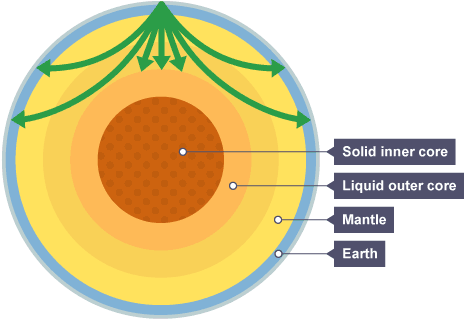
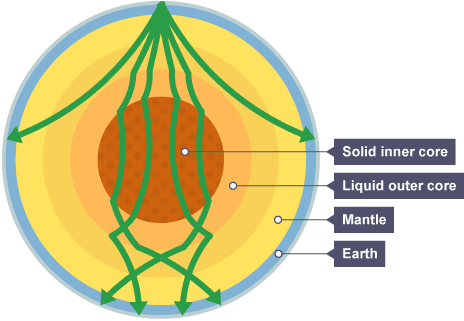
Seismic waves from large earthquakes are detected around the world. Their paths are curved as the waves refract due to the gradually changing density of the layers.
S-waves are not detected on the opposite side of the Earth – this suggests that the mantle has solid properties, but the outer core must be liquid.
P-waves are detected on the opposite side of the Earth. Refractions between layers cause two shadow zones where no P-waves are detected. The size and positions of these shadow zones indicate there is a solid inner core.
Lenses
Lenses are precisely shaped pieces of glass that have been developed and used in corrective glasses, telescope, microscopes, binoculars, and magnifying glasses.
Convex and concave lenses
A lens is a shaped piece of transparent glass or plastic that refracts light. When light is refracted it changes direction due to the change in density as it moves from air into glass or plastic. Lenses are used in cameras, telescopes, binoculars, microscopes and corrective glasses. A lens can be convex or concave.
Convex lenses
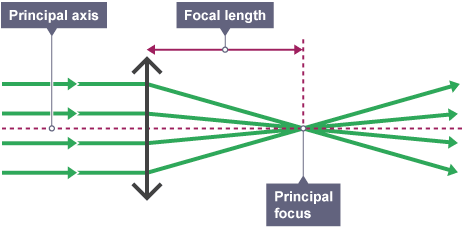
A convex lens is thicker in the middle that it is at the edges. Parallel light rays that enter the lens converge. They come together at a point called the principal focus.
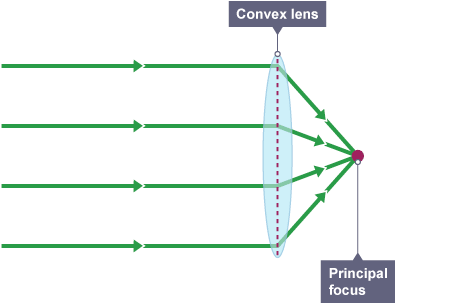
In a ray diagram, a convex lens is drawn as a vertical line with outward facing arrows to indicated the shape of the lens. The distance from the lens to the principal focus is called the focal length.
Concave lenses
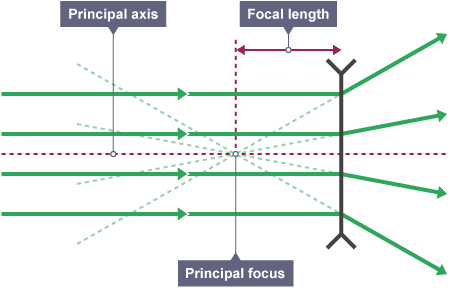
A concave lens is thinner in the middle than it is at the edges. This causes parallel rays to diverge. They separate but appear to come from a principle focus on the other side of the lens.
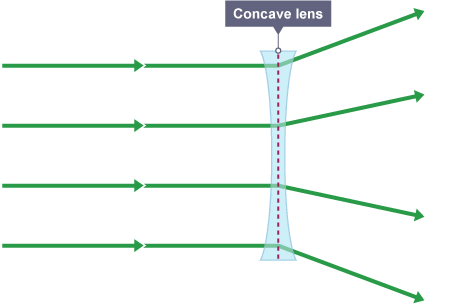
In a ray diagram, a concave lens is drawn as a vertical line with inward facing arrows to indicate the shape of the lens.



0 Comments